
The Southern Strategy refers to a political strategy used by the Republican Party in the mid-to-late 20th century to gain political support among white voters in the Southern United States by appealing to racial grievances and resistance to civil rights reforms. This strategy capitalized on shifting political loyalties in the South during and after the Civil Rights Movement. The Southern Strategy was a result of gains in racial justice and social uprisings. Legal scholar Derrick Bell in his analysis of racial progress highlighted a pattern of backlash or retrenchment following periods of perceived racial progress. He posited that gains made by marginalized groups are often met with resistance or diluted over time, as those in power work to reassert the status quo, examples include the dismantling of affirmative action programs, the gutting of the Voting Rights Act in recent years, and the rise of policies that disproportionately impact communities of color. See the Myth of Racial Progress.
Setting the stage:
Civil Rights Movement (1950s–1960s) was in full swing. The push for desegregation, voting rights, and racial equality led to significant political changes, including the Civil Rights Act of 1964 and the Voting Rights Act of 1965. These measures were championed largely by Democrats, though they faced resistance from Southern Democrats (Dixiecrats). Southern whites, who had historically supported the Democratic Party, began to feel alienated by the national party’s embrace of civil rights and social change. In an effort to capitalize on the divisions in the democratic party, Republicans exploited the racial tensions by appealing to white voters’ fears of integration, busing, and loss of traditional social hierarchies. The use of “dog whistle” politics became embedded in Republican’s language. While politicians avoided overtly racist language, they instead used coded terms like “states’ rights,” “law and order,” and opposition to “forced busing” to signal support for segregationist sentiments without explicit racism. By emphasizing conservative values, including opposition to federal intervention in states’ affairs and social programs, Republicans attracted white Southern voters who felt disconnected from the increasingly progressive Democratic Party.
Some Key Figures:
- Barry Goldwater (1964 Presidential Candidate): Goldwater opposed the Civil Rights Act of 1964, gaining significant support in the Deep South.
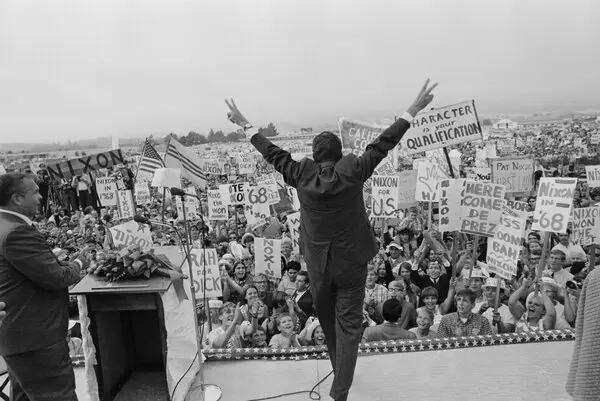
- Richard Nixon (President, 1969–1974): Nixon’s campaign employed the “Southern Strategy,” focusing on “law and order” to appeal to voters upset by civil rights protests and social unrest.
- Ronald Reagan (President, 1981–1989): Reagan furthered the strategy, emphasizing small government, states’ rights, and welfare reform, using racist tropes. (see upcoming posts on this guy. sigh)
The South transitioned from a Democratic stronghold to a Republican-dominated region by the 1980s. The strategy reinforced racial divisions and polarized U.S. politics along racial and regional lines. The strategy institutionalized racial resentment as a political tool and contributed to systemic racism in American society.
What do you notice in today’s political climate?:
The legacy of the Southern Strategy can be seen in ongoing debates about voter suppression, racial equity, and political polarization. Its influence persists in how race and identity are used in political discourse today.
** Note: The Southern Strategy employed “coded language” to create division, Republican politicians now lob overt racial insults and stereotypes.
Trump borrows from Nixon’s Southern Strategy
Donald Trump’s Southern Strategy