The Republican Party in the United States has undergone significant changes over the decades, reflecting shifts in political ideologies, demographics, and societal values. Many Republicans of history would not recognize their party today.
First a little history (Mid-19th to Early 20th Century):
The Republican Party was founded in 1854 as an anti-slavery party, opposing the expansion of slavery into new territories. Abraham Lincoln, the first Republican president, led the country through the Civil War and worked to abolish slavery. The Reconstruction era, which followed the Civil War, was turbulent. This period was marked by both hope and violence. The 13th, 14th, and 15th Amendments were passed, and the participation of African Americans in southern public life after 1867 was by far the most radical development of Reconstruction. Black people won elections to southern state governments and to the U.S. Congress during this period. Reconstruction’s other achievements were the South’s first state-funded public school systems, more equitable taxation legislation, laws against racial discrimination in public transport and accommodations, and ambitious economic development programs (including aid to railroads).

Check out this resource on Documenting Reconstruction Violence
Reconstruction ended when The Compromise of 1877 was agreed upon between southern Democrats and allies of the Republican Rutherford Hayes to settle the result of the 1876 presidential election. As Derrick Bell asserts in his theory on the myth of racial progress, there is always a backlash and retrenchment of policies and laws following any gains made by People of Color. During Reconstruction, and indeed for decades after, the Ku Klux Klan and other white supremacist organizations (as well as everyday white citizens) terrorized, brutalized, and murdered Black people. This form of control and terror was supported tacitly and often directly by local law enforcement. To counter any gains by Black people, southern states enacted “Black Codes,” Sharecropping, Convict Leasing, and Jim Crow Laws. It is important to note that northern states had their form of Jim Crow as well. (see also: Jim Crow of the North)
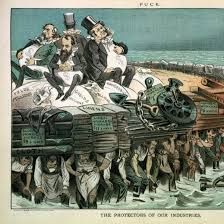
By the early 20th century, the Republican party increasingly aligned with business interests, advocating for free-market policies and limited government intervention in the economy. The party supported high tariffs and was generally pro-business, appealing to industrialists and the wealthier classes. In the 1950s, under President Dwight D. Eisenhower, the party maintained a centrist stance, supporting moderate social welfare policies and infrastructure development (e.g., the Interstate Highway System).
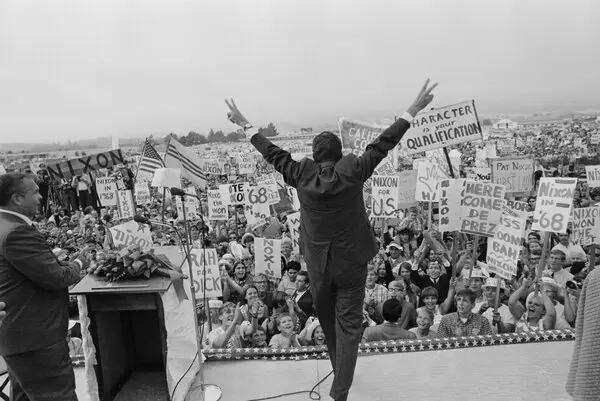
In the late 20th century, there was a conservative shift with Goldwater and Reagan’s rise and the implementation of the Southern Strategy. Barry Goldwater’s 1964 presidential campaign marked a shift towards conservatism, emphasizing small government, individual liberty, and a strong anti-communist stance. Ronald Reagan’s presidency further solidified conservative dominance, focusing on tax cuts, deregulation, a strong military, and a reduction in social welfare programs. The Southern Strategy also realigned the party by appealing to white Southern voters disillusioned with the Democratic Party’s support for civil rights. The late 20th century saw the rise of social conservatism, with the Republican Party increasingly aligning with religious and socially conservative groups. Issues such as abortion, school prayer, and traditional family values became central to the party’s platform.

The Republican Party courted evangelicals as part of a strategic political realignment that began in the 1970s and continued through the 1980s. This alliance was driven by mutual interests in promoting conservative “social values,” countering the cultural shifts of the 1960s, and solidifying political power. More specifically, Republicans were seeking to stop any further progress gained by people of color and women through the Feminist movement and the Civil Rights movement of the 1960’s. The 1960s brought significant social changes, including the civil rights movement, the sexual revolution, and the push for women’s rights, which many evangelicals and Republicans viewed as threatening “traditional values.”
Republicans saw an opportunity with the emergence of the religious right, a coalition of conservative evangelical Christians who opposed abortion and felt threatened by the expansion of civil rights. Leaders like Jerry Falwell and organizations such as the Moral Majority began to exert significant influence on Republican politics, framing abortion as a central moral issue. The Democratic Party’s increasing support for reproductive rights led many socially conservative Democrats, again, especially in the South, to align with the Republican Party. Seeing the writing on the wall, the Republican party began to adopt a more explicit pro-life stance to attract these voters and solidify the support of religious conservatives for political expediency.
The 21st century Republican party led by George W. Bush saw a focus on national security in the aftermath of September 11th, the War on Terror, and the Iraq War. Domestically, Bush promoted tax cuts and attempted to reform Social Security, but also faced criticism for expanding federal government through programs like Medicare Part D.

The late 2000s and early 2010s saw the rise of the Tea Party movement, which pushed the party further right, emphasizing fiscal conservatism, smaller government, and opposition to the Affordable Care Act. The Tea Party claimed that their formation was in response to eonomic concerns, however, racism and a backlash to the first Black president was threaded throughout the movement. This movement influenced the Republican Party to adopt a more combative stance against perceived government overreach. This shift continues to be seen in today’s Republican party.
Donald Trump’s first presidency (2017-2021) marked a shift towards populism, nationalism, and authoritarianism.
The Republican Party has transitioned from its 19th-century roots in anti-slavery and Reconstruction to a 20th-century focus on business, free markets, and conservatism, and more recently, to a party influenced by populism and fascism. The current state of the Republican party is an example of decades of politicians responding to fear and political expediency.
Notice the parallels between the Republican Party’s response to the Civil Rights Movement of the 1960s, its response to the Uprisings of 2020, and the subsequent DEI efforts in public and private institutions.