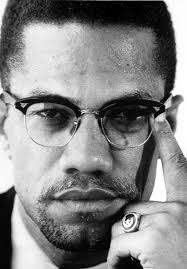

Malcolm X, a prominent African American leader and activist, made significant contributions to the Civil Rights Movement in the United States, particularly through his advocacy for Black empowerment, self-determination, and justice. His life and work profoundly influenced the struggle for racial equality and the discourse on race in America.
Malcolm X championed Black pride and self-sufficiency, encouraging African Americans to take control of their communities and economic futures. He promoted the idea of self-defense against racial violence, contrasting with the nonviolent approach of other civil rights leaders.
“Concerning nonviolence, it is criminal to teach a man not to defend himself when he is the constant victim of brutal attacks.”
Malcom X spoke out against the pervasive racism in American institutions and the economic exploitation of Black people. Malcolm X brought a critical analysis to the structure of white supremacy and how entrenched anti-Blackness is systemically.
“When we see that our problem is so complicated and so all-encompassing in its intent and content, then we realize that it is no longer a Negro problem, confined only to the American Negro; that it is no longer an American problem, confined only to America, but it is a problem for humanity.”
Many white Americans viewed Malcolm X as a dangerous radical due to his outspoken criticism of systemic racism and his advocacy for Black self-defense. Malcolm X’s rhetoric, especially early in his career with the Nation of Islam, was often perceived as hostile to white people. This led to widespread media portrayal of him as a militant figure.
“Brothers and sisters, I am here to tell you that I charge the white man. I charge the white man with being the greatest murderer on earth. I charge the white man with being the greatest kidnapper on earth. There is no place in this world that this man can go and say he created peace and harmony. Everywhere he’s gone, he’s created havoc. Everywhere he’s gone, he’s created destruction.” (Author’s note: No Lies Detected in this statement)
Efforts to pit Malcolm X against Martin Luther King Jr. were common during their lifetimes and were often fueled by media narratives, political figures, and differing strategies within the Civil Rights Movement. These efforts highlighted their contrasting approaches but overlooked their shared goals of achieving racial equality and justice. The media often framed Malcolm X and Martin Luther King Jr. as ideological opposites, with King representing nonviolence and integration, and Malcolm X representing militancy and separatism. This binary portrayal simplified their complex philosophies and ignored the nuances in their evolving perspectives.
“The media’s the most powerful entity on earth. They have the power to make the innocent guilty and to make the guilty innocent, and that’s power. Because they control the minds of the masses.”
Politicians and law enforcement, including the FBI under J. Edgar Hoover, sought to exploit the differences between the two leaders to undermine the Civil Rights Movement. The FBI’s COINTELPRO program aimed to sow discord among civil rights leaders, using surveillance and propaganda to create divisions and weaken the movement.
After his pilgrimage to Mecca in 1964, Malcolm X adopted a more inclusive perspective, advocating for human rights and unity across racial lines. He founded the Organization of Afro-American Unity (OAAU), focusing on the global struggle for the rights of African Americans. His ideas on Black nationalism and self-determination laid the groundwork for later movements, such as the Black Power movement. Malcolm X’s emphasis on pride and self-respect resonated with many African Americans and influenced cultural and political thought. Malcolm X’s legacy lies in his unwavering commitment to justice, his ability to articulate the frustrations of the Black community, and his evolution toward a more inclusive approach to human rights. His speeches and writings continue to inspire discussions on race, identity, and empowerment.
“I’ve had enough of someone else’s propaganda… I’m for truth, no matter who tells it. I’m for justice, no matter who it is for or against. I’m a human being first and foremost, and as such I’m for whoever and whatever benefits humanity as a whole.”
Malcolm X on white people’s guilt