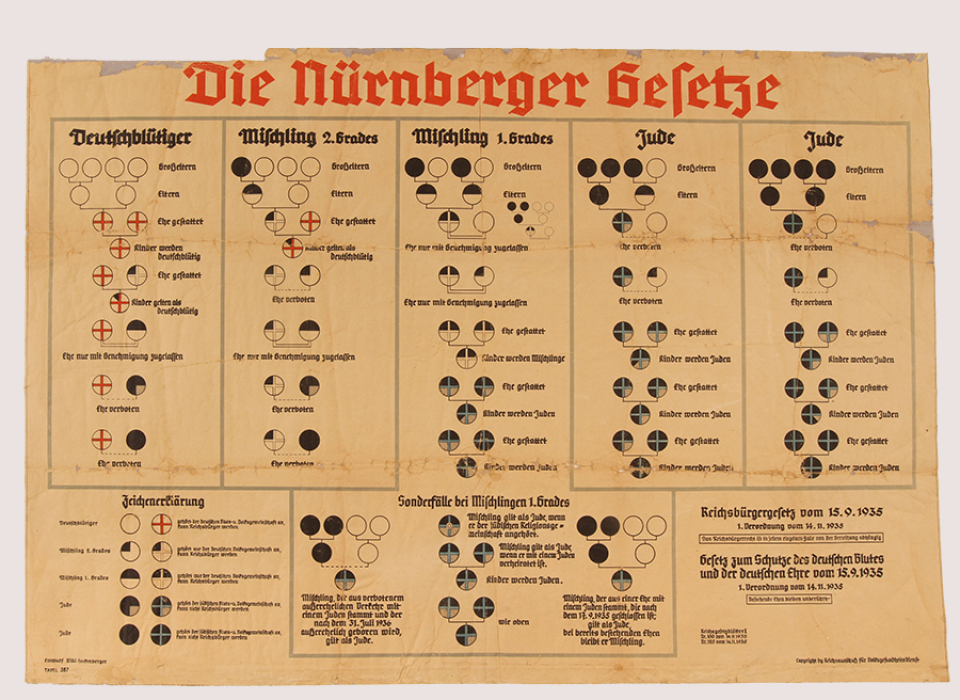
In 1935, Nazi Germany passed two radically discriminatory pieces of legislation inspired by American laws: the Reich Citizenship Law and the Law for the Protection of German Blood and German Honor. Together, these were known as the Nuremberg Laws, and they laid the legal groundwork for the persecution of Jewish people during the Holocaust and World War II.
Hitler’s Study of American Race Laws:
Hitler admired the way the United States had legally entrenched racial segregation and discrimination, particularly through Jim Crow laws, anti-miscegenation laws, and the eugenics movement. The American eugenics movement, which promoted the idea of improving the genetic quality of the human population by controlling breeding, was a significant influence on Nazi ideology. The U.S. had implemented sterilization laws targeting those deemed “unfit” to reproduce, which Nazis studied and expanded upon. U.S. laws prohibiting interracial marriage and relationships inspired the Nazis to create similar laws to maintain the “purity” of the Aryan race. The Nazis were impressed by the detailed racial classifications in some U.S. states that regulated interracial relations. James Q. Whitman, author of Hitler’s American Model writes, “America in the early 20th century was the leading racist jurisdiction in the world. Nazi lawyers, as a result, were interested in, looked very closely at, [and] were ultimately influenced by American race law.”
Nuremberg Laws and U.S. Influence:
The Nazis looked to American laws for examples of how to classify people based on race. Some U.S. states had “one-drop rules” that defined a person as black if they had any African ancestry. Laws also defined what made a person Asian or Native American to prevent these groups from marrying whites (notably, Virginia had a “Pocahontas Exception” for prominent white families who claimed to be descended from Pocahontas). The Nuremberg Laws, too, came up with a system of determining who belonged to what group, allowing the Nazis to criminalize marriage and sex between Jewish and Aryan people, just like the anti-miscegenation laws in the United States. The Nazis did not adopt the “one-drop rule” but instead decreed that a Jewish person was anyone who had three or more Jewish grandparents. Which means, as Whitman notes, “that American racial classification law was much harsher than anything the Nazis themselves were willing to introduce in Germany.”
The Nazis saw the U.S. legal system as a precedent for creating a society divided along racial lines, enforced through laws and regulations. The segregation of public spaces and the disenfranchisement of African Americans served as models for similar policies in Nazi Germany.
The study of American race laws provided the Nazis with a framework for constructing their own legal system of racial discrimination and segregation.
Teaching Materials on Nazism and Jim Crow