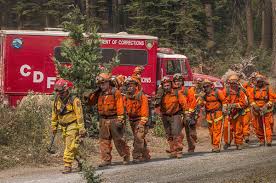
As the fires have been raging in Los Angeles we have been learning about the incarcerted firefighters that have been on the frontlines of battling the fires. The firefighters are a part of the Conservation Camps Program through the state of California. There has been increasing attention and critique of this program as we learn more about the long hours, little pay and conditions experienced by these firefighters. It is reminiscent of the practice of convict leasing which has its roots in slavery. The following article gives a brief history of convict leasing, and its connection to today.
Convict leasing was a system used primarily in the Southern United States after the Civil War and during the Reconstruction era, in which prisoners were leased out to private companies or individuals to perform labor. This system began around 1865 and persisted into the early 20th century.
It arose as a response to the abolition of slavery. Southern states sought ways to rebuild their economies through free labor and control over African Americans. After the Civil War, African Americans were often targeted by laws designed to criminalize minor offenses, a practice known as “Black Codes,” and Jim Crow law. These laws led to high incarceration rates and a continuation of forced labor through the criminal justice system (in some cases, individuals were forced into labor to pay off debts: debt peonage). Convict leasing served as a means to continue the racial subjugation of African Americans, maintaining white supremacy by reinforcing racial hierarchy and the social order of the antebellum South through keeping African Americans in subservient roles and dependent on white people for their livelihood. States would lease convicts to private industries such as plantations, railroads, mines, and factories. The lessees were responsible for housing and feeding the prisoners, while the state benefited from reduced incarceration costs and revenue from the leases. Convict leasing was notorious for its brutal conditions. Prisoners often worked long hours in harsh environments, received minimal sustenance, and were subjected to physical abuse. Convict leasing is often seen as a continuation of slavery due to several key factors that highlight how it perpetuated the economic and social dynamics of the pre-Civil War era. The 13th Amendment to the U.S. Constitution abolished slavery, except as punishment for a crime. This loophole was exploited to legally force convicts, primarily African Americans( as a result of Black Codes and Jim Crow), into labor, essentially re-enslaving them through the criminal justice system. Like slavery, convict leasing provided a source of extremely cheap labor. Convict leasing continued many of the exploitative and oppressive aspects of slavery under a different legal framework, ensuring that African Americans remained economically and socially disadvantaged long after the abolition of slavery.
Public outcry over the inhumane treatment of convicts, along with labor reforms and changes in the penal system, led to the gradual decline of convict leasing. By the early 20th century, most states had abolished the practice, though forced labor persisted in other forms.

After the formal abolition of convict leasing, several systems emerged that continued the exploitation of incarcerated individuals, maintaining elements of control and forced labor reminiscent of convict leasing. Chain gangs became prominent in the late 19th and early 20th centuries, particularly in the Southern United States. Inmates, often shackled together, were forced to perform hard labor such as building roads, clearing land, and other public works projects. Prison farms, particularly in the South, replaced convict leasing with systems where inmates worked on large plantations or agricultural enterprises owned by the state. These farms were often remnants of antebellum plantations and operated similarly, with prisoners subjected to grueling labor in fields. Many states established their own penal industries within prisons, where inmates worked in manufacturing, textiles, or other industrial sectors. The profits from these enterprises were used to fund the prison system, while inmates were paid little or nothing. Inmates were often employed in public projects such as building roads, dams, and public buildings, continuing the legacy of forced labor for state benefit. Today’s prison labor systems, where inmates work for minimal wages in public or private enterprises, are seen by many as a continuation of these historical practices. Although participation in some programs is voluntary, like the Conservation Camps Program, the conditions and low pay echo the exploitative nature of convict leasing.
The penal system’s exploitation of incarcerated people has evolved over time but the practices maintain the core elements of convict leasing: forced labor, minimal compensation, harsh conditions, and the disproportionate targeting of African Americans and other marginalized groups.