
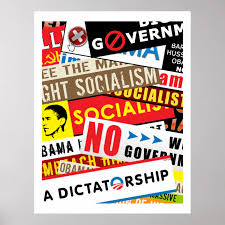
Right-Wing Use of Propaganda:
The right wing’s “fear” of socialism and communism—especially in the U.S.—has been deeply strategic, emotional, and racialized. While often framed as an ideological concern about “freedom” or “government control,” it has historically functioned as a tool to maintain the status quo: preserving white supremacy, protecting corporate power, and undermining collective organizing among working-class people and communities of color.
The Right Wing’s “Fear” of Socialism:
1. Loss of Individual Wealth and Property
- Fear: That socialism means redistributing wealth from the wealthy (often white) to the poor (often racialized as undeserving).
- Function: Protect capitalist hierarchies and private control over resources.
- Code words: “They want to take what you’ve earned and give it to people who won’t work.”
2. Government Overreach and Loss of “Freedom”
- Fear: That socialism leads to authoritarianism or totalitarianism.
- Function: Undermine public programs and justify deregulation.
- Code words: “Big government,” “nanny state,” “socialized medicine,” “death panels.”
3. Erosion of Traditional Social Hierarchies
- Fear: That socialism promotes gender, racial, and sexual equity—challenging white Christian patriarchy.
- Function: Mobilize backlash against civil rights, feminism, and queer liberation.
- Code words: “Cultural Marxism,” “woke mob,” “destroying the family,” “indoctrination.”
4. Undermining of American Exceptionalism and Capitalist Identity
- Fear: That socialism is un-American, foreign, or associated with enemies (e.g., USSR, China, Cuba).
- Function: Link leftist ideas with treason and weaken global solidarity movements.
- Code words: “Enemy of freedom,” “communist sympathizer,” “radical left.”
PROPAGANDA USED TO STIFLE PROGRESS:
| Tactic | Examples | Purpose |
|---|---|---|
| Red-baiting | Accusing MLK, Angela Davis, Bernie Sanders, and even teachers of being communists | Discredits justice work by associating it with foreign threats |
| Media fear campaigns | Fox News calling universal healthcare “tyranny”; ads showing mobs and empty shelves | Equates public goods with crisis and collapse |
| Historical revisionism | Painting the Cold War as a fight for “freedom,” ignoring U.S. coups | Erases the violence done in the name of anti-communism |
| Demonizing public investment | “Socialism never works,” “they’ll take your doctor,” “school choice = freedom” | Keeps services privatized and profit-driven |
| Racial dog whistles | “Welfare queens,” “makers vs. takers,” “they want reparations” | Ties economic justice to racial fear to divide working-class unity |
The Left’s “Fear” of Socialism:
Moderate Democrats—often called centrists or establishment Democrats—tend to express fears about socialism that are distinct from the hardline rhetoric of the right, but still rooted in concerns about electability, economic stability, and public perception. Their apprehension isn’t usually about gulags or authoritarianism—it’s about political pragmatism, preserving a capitalist framework, and avoiding alienation of key voter blocs.
1. Electability and Public Perception
Fear: The label of “socialism” will hurt Democrats in swing states or red districts.
- “Americans don’t want a revolution; they want results.” — Joe Biden, 2020
- “Call something ‘socialist’ and it dies in Florida.” — in reference to Latinx voters with memories of authoritarian regimes (e.g., Cuba, Venezuela)
Moderates worry that embracing socialist language will hand Republicans easy attack lines and make the party appear out of touch with middle America.
2. Economic Disruption
Fear: Radical redistribution will destabilize the economy or discourage innovation.
- Concerns about universal basic income, free college, or abolishing private insurance tend to revolve around how to fund them, not just ideological opposition.
- Many moderates support safety nets, but within a market-based framework (e.g., ACA instead of Medicare for All).
This isn’t a defense of the ultra-rich, but a belief that capitalism, reformed and regulated, is the most workable system.
3. Institutional Caution and Incrementalism
Fear: Pushing too fast or too far will backfire, both in Congress and the courts.
- Moderates often emphasize bipartisanship, norms, and stability.
- They believe big change comes through coalitions and compromise, not sweeping systemic shifts.
For example, while progressives might demand “abolish ICE,” moderates lean toward “reform immigration enforcement.”
4. Generational and Cultural Gaps
Fear: Socialist language can alienate older voters, union workers, and immigrants.
- Many elders remember Cold War messaging and equate socialism with government overreach or scarcity.
- Moderate Democrats often try to hold together multiracial coalitions that include both youth activists and older voters who might be wary of radical framing.
5. Preservation of a “Capitalist with a Conscience” Model
Fear: Throwing out capitalism altogether undermines prosperity and personal freedom.
- Centrists often invoke FDR-style New Deal values: strong regulation, labor protections, and progressive taxes—but not public ownership of industry or abolishing billionaires.
- Their ideal is a “just capitalism,” not democratic socialism.
Summary
| Moderate Democrat Fear | Underlying Concern |
|---|---|
| “Socialism” as a toxic label | Electoral vulnerability |
| Too much change, too fast | Institutional backlash |
| Risk of economic instability | Need to maintain growth/investment |
| Alienating key demographics | Holding together a big tent |
| Losing the moral claim to pragmatic governance | Appearing too radical |
