Since the early 20th century, the white power structure in the United States has strategically weaponized fear of socialism and communism to discredit movements for racial, economic, and social justice. This fear-mongering has served as a powerful political tool—used not to protect democracy, but to maintain the racialized status quo and suppress redistribution of power and resources.
The First Red Scare
In the aftermath of World War I and the Russian Revolution, fear of socialist and anarchist uprisings led to the Palmer Raids, targeting labor organizers and immigrants . Propaganda painted activists as foreign threats—spies bent on undermining American democracy. This legitimized the suppression of free speech and the deportation of suspected “radicals.”
After World War I, as Black communities and immigrant workers began organizing for better wages and civil rights, the white ruling class grew increasingly anxious about shifts in the racial and economic hierarchy. The Russian Revolution of 1917 gave American elites a potent propaganda tool: they began labeling any worker resistance, union activity, or demands for racial equity as “Bolshevik” or “Red.”
During the First Red Scare (1919–1920), thousands were arrested or deported, not for any crime, but for their political beliefs or immigrant status. Prominent Black leaders like A. Philip Randolph and W.E.B. Du Bois, who supported labor rights and economic justice, were accused of spreading communist ideals—painting social justice as a foreign threat.
The First Red Scare’s Propaganda Tools: Posters, newspapers, speeches
- Immigrants as “Red Threats”: Political cartoons portrayed Eastern European and Jewish immigrants as bomb-throwing anarchists or spies.
- “The Bolsheviki Menace”: Pamphlets and news headlines warned that labor strikes and racial unrest were being orchestrated by foreign radicals, often with antisemitic undertones.
- “Americanism” vs. Radicalism: Organizations like the American Legion promoted 100% “Americanism” as a way to purge schools, unions, and public life of socialist influence—often code for suppressing working-class activism.
Cold War Era
During the Cold War, fears of Soviet infiltration intensified. McCarthy and HUAC accused countless individuals—government workers, educators, artists—of being Communist sympathizers. The Communist Control Act (1954) outlawed membership in the Communist Party . Socialist policies were portrayed as a Trojan horse for authoritarianism, justifying censorship, blacklists, and loyalty tests against opponents.
The Second Red Scare during the Cold War reached new levels under McCarthyism in the 1950s. As the civil rights movement gained momentum, the U.S. government and media often painted civil rights activists as communist sympathizers. Dr. Martin Luther King Jr. was repeatedly surveilled by the FBI, which sought to discredit him and other Black leaders by tying them to the Soviet Union.
This tactic was deeply racialized. Demands for desegregation, voting rights, or police accountability were not treated as legitimate democratic actions—they were rebranded as threats to “American values.” These values were often code for preserving white supremacy and capitalist control.
For decades, “socialism” and “communism” became dirty words in U.S. politics. Even universal policies (e.g., Social Security, public housing) were discredited as “socialist incentives.” The government, aided by influential media, propagated myths about socialism as anti-American and totalitarian, suppressing genuine discussions about collective welfare .
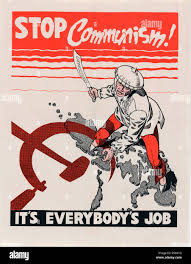
The Cold War’s Propaganda Tools: Films, television, FBI literature, school curricula

- Films like Red Nightmare (1962): Sponsored by the U.S. Department of Defense, this short film shows a suburban American father waking up in a communist regime—where churches are closed, neighbors inform on each other, and families are torn apart.
- FBI Comics: Distributed to schoolchildren, these warned that communists were infiltrating Black communities and unions, pretending to care about civil rights only to destroy America from within.
- “If you’re not with us, you’re with the Reds”: Anyone advocating for racial integration or labor rights could be accused of subversion. MLK Jr. and Paul Robeson were surveilled and slandered with these tactics.
Post-1960s to Reagan
After civil rights laws were passed, the backlash took economic form. The rise of welfare programs in the 1960s and 1970s—many of which disproportionately benefited Black and brown communities—were attacked as socialist experiments. By the 1980s, Ronald Reagan’s famous dog-whistle about “welfare queens” and “big government,” embedded the idea that social programs (especially those helping poor, nonwhite people) were dangerous steps toward communism.
The narrative was simple and effective: social justice = socialism = communism = un-American. This false equivalency was used to gut public housing, underfund schools, and criminalize poverty—all while enriching corporations and the white upper class.
Post 1960’s to Reagan’s Propaganda Tools: Political ads, campaign speeches, think tank publications
- Barry Goldwater & Ronald Reagan: Both linked civil rights legislation and social welfare to creeping socialism. Reagan said Medicare would mean “you and I are going to spend our sunset years telling our children and our children’s children what it once was like in America when men were free.”
- Welfare = Socialism: Right-wing media began framing welfare recipients (especially Black women) as lazy burdens on “tax-paying Americans.” “Welfare queen” was not just a racist stereotype—it was a dog whistle against redistributive justice.
- Think Tanks: Groups like the Heritage Foundation pushed white papers conflating social programs with Soviet-style socialism, influencing both public perception and policy.
21st Century
Today, this tactic is alive and well. Politicians and media pundits continue to equate progressive policies—like Medicare for All, student loan forgiveness, or the Green New Deal—with authoritarian socialism. When Black and brown lawmakers (e.g., Alexandria Ocasio-Cortez, Ilhan Omar, Zohran Mamdani) push for redistributive justice, they are branded as radical or dangerous.
These smears tap into old fears: that giving marginalized communities power will disrupt white dominance. The goal isn’t to critique policy—it’s to delegitimize the very idea that justice and equity are American.

21st Century’s Propaganda Tools: Cable news, social media, memes, legislation
- Fox News and the “Socialist Agenda”: Progressive figures like Bernie Sanders and Alexandria Ocasio-Cortez are regularly labeled “radical socialists” who want to “destroy America.”
- “Antifa = Communist Insurgency”: Protests against police violence have been portrayed as coordinated Marxist plots.
- Anti-CRT and Book Bans: School board campaigns warn that teaching about racism, colonialism, or systemic inequality is “Marxist indoctrination”—a chilling echo of McCarthy-era fear.
The Real Threat
Ironically, the white power structure has often been willing to erode democratic norms—through voter suppression, corporate control of elections, and militarized policing—to “protect” the country from the specter of socialism. In doing so, they reveal the truth: it’s not communism they fear. It’s justice.
Today
Zohran Mamdani’s primary win in New York City marks a new front in this long-running tactic. As a democratic socialist, his progressive platform (e.g., rent freezes, universal childcare) has triggered fierce backlash:
- Right-wing and GOP leaders labeled him a “pure communist” and “radical left lunatic,” promising punitive financial consequences from the federal level if he implements his agenda
- Conservatives and Moderate/Establishment Democrats used nostalgia and fear, invoking terms like “extremist” to erode his credibility .
- Islamophobic undertones surfaced in reaction to Mamdani’s Muslim background and advocacy, with critics exploiting coded xenophobic and religious anxieties .
This historical throughline demonstrates that when progressive policies emerge, so too does the specter of socialism/communism—used not to critique ideas, but to stifle them. The label “communist” is wielded not as analysis but as stigma—to stoke fear, pressure institutions, and obstruct new social policy.
Themes Across the Decades
- Social justice = foreign threat
- Black resistance = communist conspiracy
- Helping the poor = destroying freedom
- Public programs = loss of individual liberty
- Solidarity = subversion
In reality, the U.S. campaign against communism has often served as a cover for advancing corporate and geopolitical interests, not democratic ideals. From Guatemala, where the CIA overthrew President Jacobo Árbenz to protect the United Fruit Company’s land holdings, to Iran, where Prime Minister Mossadegh was removed after nationalizing oil, the U.S. has repeatedly undermined democratically elected leaders under the guise of fighting socialism. In Chile, Salvador Allende’s socialist government was toppled in a brutal coup supported by the U.S., paving the way for decades of dictatorship. These are not isolated incidents—they are part of a broader pattern where the language of freedom masks economic self-interest and neocolonial control. In the following articles, we’ll explore how these interventions abroad were justified through anti-communist rhetoric, and how that same rhetoric continues to be weaponized at home to derail progressive reforms and silence movements for racial and economic justice. But, first up, Iran.
Check out this quick guide of the Right and Left’s propaganda around socialism